Thorium power,
refuelled while running
Qark One is a thorium-fuelled reactor of about 300 MWe, designed from published data for India’s AHWR-300 LEU. Its coolant circulates without pumps, its fuel is changed while it runs, and it can cool itself for 72 hours with no power or operators.
-
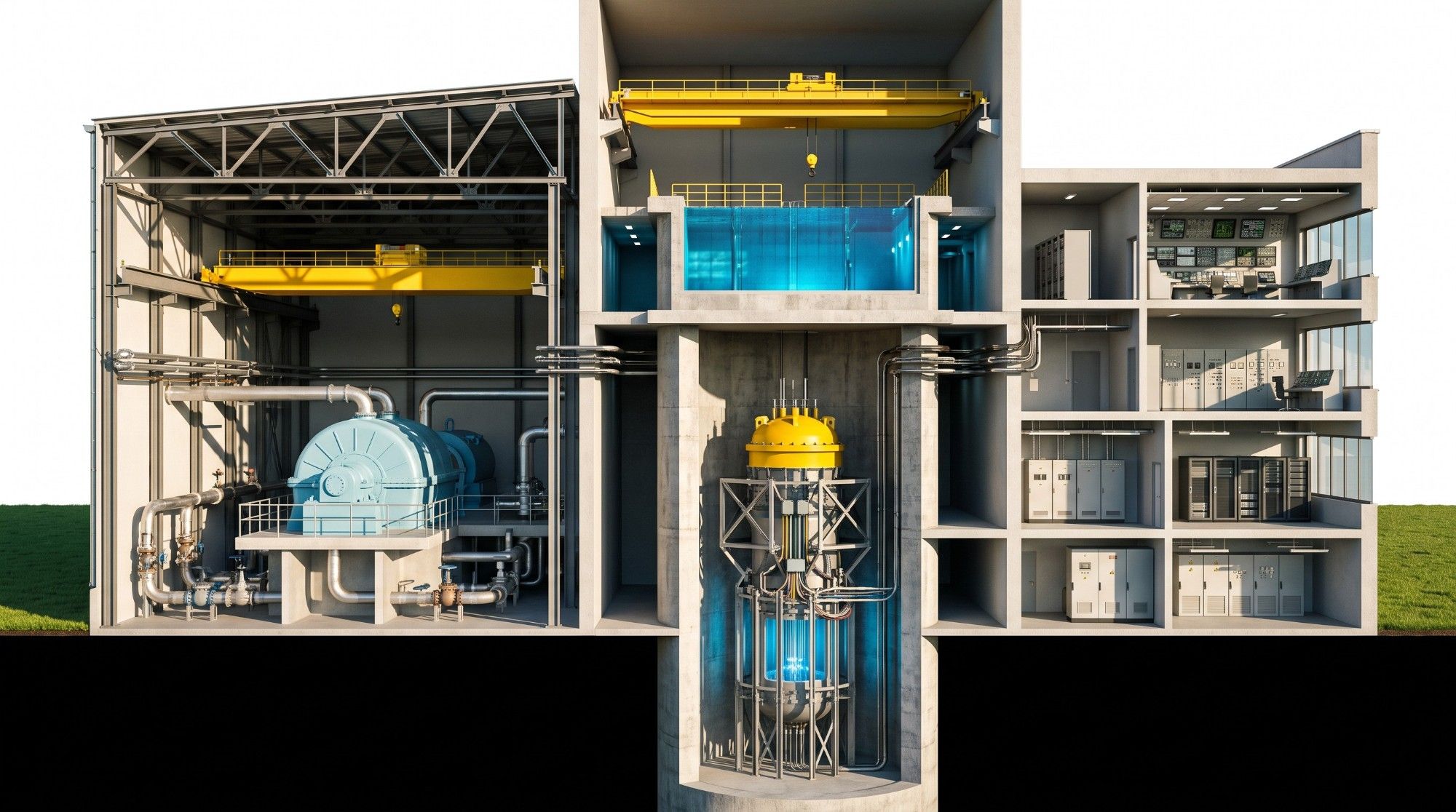
Turbine hall
Steam from the reactor drives a turbine-generator.
-
Reactor building
The reactor, with a large pool of water held above it.
-
Control building
The control room, electrical and instrumentation systems.
How Qark One works
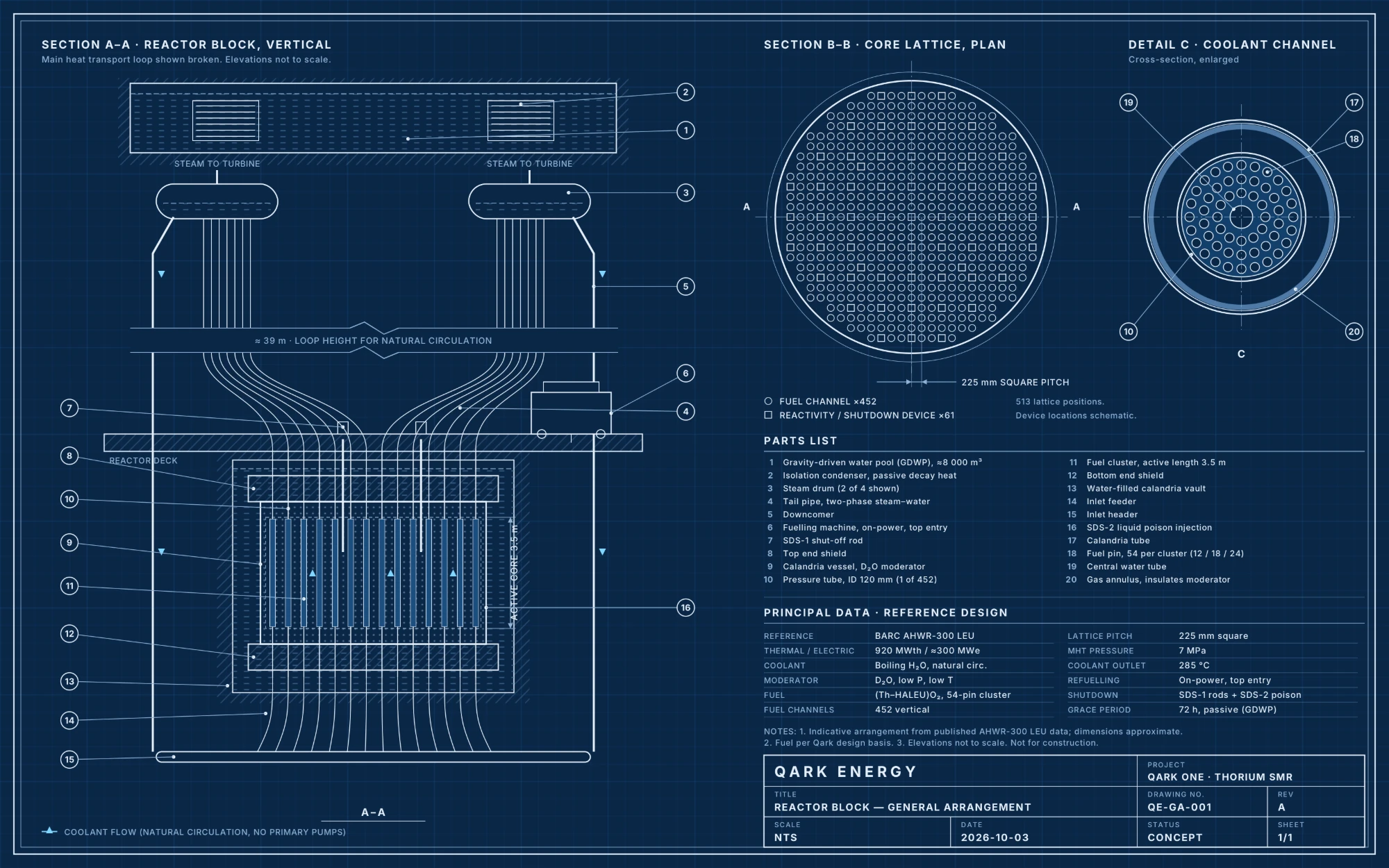
Qark One is a pressure-tube reactor. Its fuel sits in 452 vertical tubes that pass through a tank of heavy water, the calandria. The heavy water slows neutrons so the thorium fuel can sustain its chain reaction, and it stays at low pressure and temperature.
Ordinary water flows up through each tube and boils as it passes the fuel. The mix of steam and water rises about 39 metres to four steam drums, where the steam is separated and sent to the turbine, while the water falls back to the bottom of the core. Gravity and the difference in density keep this loop moving, so the main circuit has no pumps.
Fuel is changed from above while the reactor keeps running, so Qark One does not need to shut down to refuel.
Three ideas at the core
-
Thorium fuel
(Th–HALEU)O₂ clusters in 452 vertical channels, with heavy water as the moderator.
-
Natural circulation
Boiling water rises through the core to the steam drums and falls back through downcomers. No primary pumps.
-
On-power refuelling
A fuelling machine on the reactor deck changes fuel from the top while the reactor keeps running.
Safe by design
Qark One is designed so that gravity and natural circulation, not pumps and operators, keep it safe when something goes wrong.
-
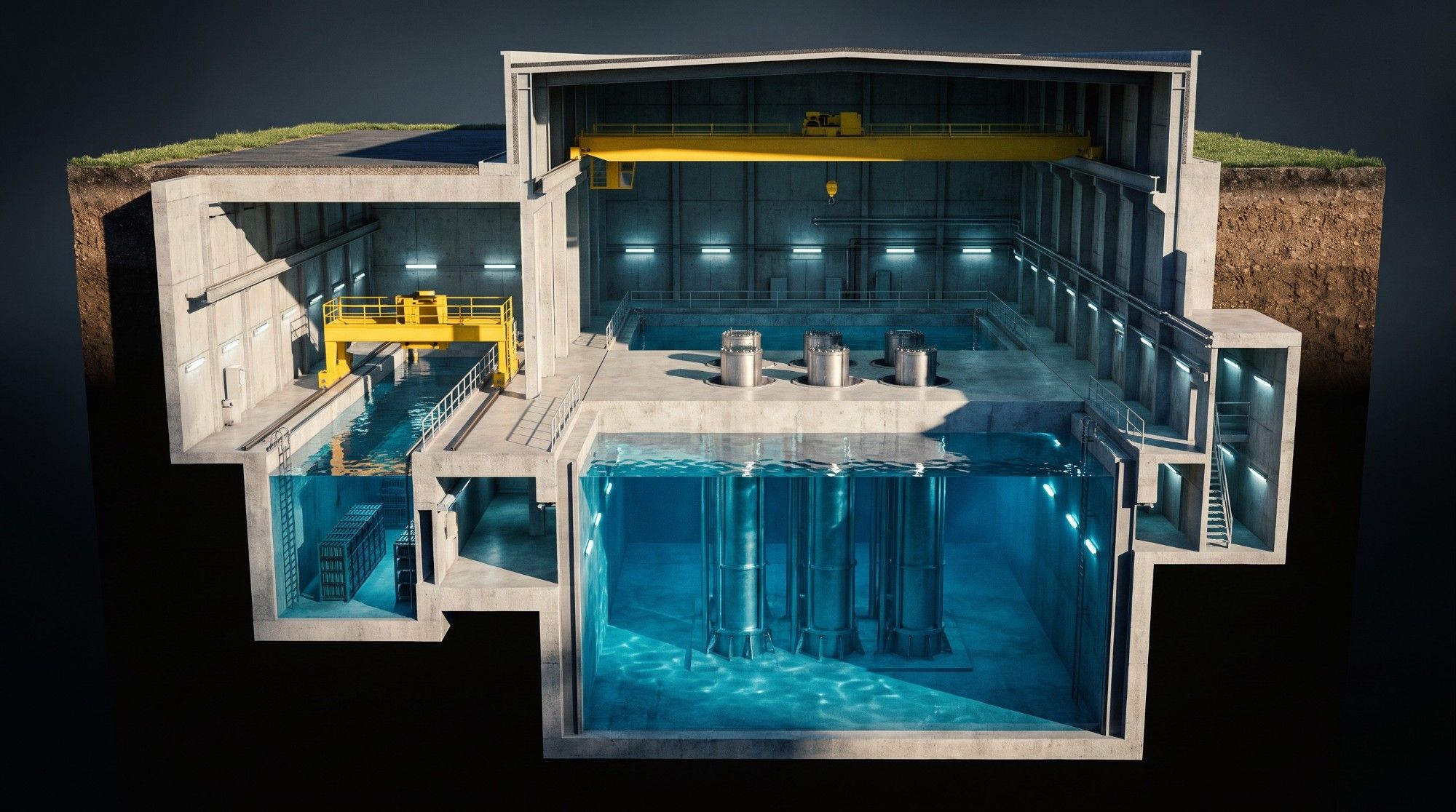
Two ways to shut down
SDS-1 drops shut-off rods into the core. SDS-2 injects a liquid neutron poison into the moderator. Either one can shut the reactor down on its own.
-
Cooling without power
Isolation condensers sit in a gravity-driven water pool of about 8,000 m³ high in the reactor building. They carry decay heat away with no pumps and no electricity.
-
72 hours of grace
If everything else fails, the plant needs no operator action and no outside power for 72 hours.
The drawing
General arrangement QE-GA-001, rev A. Concept status, not for construction.
Principal data
Reference values from drawing QE-GA-001, indicative of published AHWR-300 LEU data. Dimensions are approximate and will change as the design develops.
Reference design
AHWR-300 LEU (BARC, published data)
Thermal / electric
920 MWth / ≈300 MWe
Coolant
Boiling light water, natural circulation
Moderator
Heavy water (D₂O), low pressure and temperature
Fuel
(Th–HALEU)O₂, 54-pin clusters
Fuel channels
452 vertical, 225 mm square pitch
Main heat transport
7 MPa, 285 °C coolant outlet
Refuelling
On power, top entry
Shutdown
SDS-1 shut-off rods, SDS-2 liquid poison
Passive cooling
72 h grace period, ≈8,000 m³ gravity-driven water pool
Lattice
513 positions: 452 fuel channels, 61 reactivity and shutdown devices
Active core length
3.5 m
Pressure tubes
120 mm inside diameter
Steam drums
Four
Natural-circulation loop height
≈39 m
Decay-heat removal
Isolation condensers in the gravity-driven water pool
Status
Concept design; not for construction